

On Editing and Sequencing
A short essay I wrote on the process of editing and sequencing:
When I am thinking about sequencing and editing, I am primarily thinking about feeling. I am thinking about how the viewer is feeling when moving through the images one by
one or two by two. I am thinking about all the elements of design and art -- at least the ones that know of, to convey a certain meaning and feeling. The first layer of information: what do I see. A horse, a fence, grass, et cetera. This gives context to the viewer, the basic level of what a photo is. Second level is shape and light - how have I used perspective and lighting when shooting to create shape and hierarchy in a composition? This allows the viewer to understand relationships between the elements of the image. You might be surprised to hear this sentence - almost sacrilege to say as a photographer. Light has not been a priority to me photographing, but it is a rising priority now when shooting with black and white film. More on this later, maybe.
Third level is color - what is the general color of the image and how is it conveying a feeling - is it a cold? Is it a warm? Is it blue? Is it green? Of course, color theory is very important. One must think of editing color in the perspective of each single image, but also throughout several photos following each other. If one photo is warm and hot like fire, and then the next one cold and blue like winter, I am sure the viewer will feel both hot and cold, but also a bit confused or whiplashed. If that is what you want to convey -- whiplash-- then great, but if not, maybe edit the colors differently, or choose another photo.
I also think about texture. The texture of wood versus the texture of stone conveys different feelings. The texture of hair lying on the grass on a summer day is different to the texture of an ocean wave clashing into a wall.
These are the elements of design that any artist, I think, should be and would be thinking about when working on a composition. I have learned this from web design classes and random youtube videos, but nothing can teach you better than application. I am now, after 4 years of photographing and editing, just beginning to understand these things in the context of photography.When I am photographing a place, this is the question I am constantly asking myself: what elements of this place should I collect to be able to paint the clearest image of this place? What stands out when feeling this place, and how would I be able to capture that feeling through the elements being presented to me. Is it the galloping of 3 horses around me in an open field? Or is the falling fence? Or is it the comical side eye of the horses? In trying to answer this question, I am in constant conversation with myself over how I can capture these elements in the science of photography. Do I need a wide lens to paint the vastness of the valley? Do I need a tighter lens to focus on one single thing? Should I have a slower shutter speed to show the movement of the horses running? Should I keep the depth of the fields shown by closing my aperture? Or should I keep it shallow to only focus on this one leaf?
And when all else fails, when I am lost, unable to answer this question, the question goes to: How will the man in the editing room be happy with the amount of elements they
have to have as many options to tell a story well. This desperation often gives you unexpected surprises. When I go into the editing room, I start using all these elements photographed, in addition to the lived experience that I had in that space, and blend it with the voice or tone I want to convey to be able to tell a story through a sequence of images. It becomes an orchestration of feeling, storytelling and playing with a puzzle of limited clues. Not an easy feat, but a great challenge. So when it comes to sequencing and editing, new questions arise: How do I introduce the story, what is the first image that will attract the reader's attention, how do I establish a place, how do I convey the feeling that it was green everywhere, is there a road (physical and metaphorical) I can take to introduce the main characters, who are the main characters? Is the place cold? Is it eerie? Is it joyful? At what stages do I introduce these feelings? What is the feeling I want to have the viewer to end with at the end of the sequence? The tip of the iceberg, but maybe you get the gist.
Photo capturing is the process of inclusion. Photo editing is the process of elimination, exclusion. Similar to filmmaking. You've gathered all these things, now what is extra fluff that is unnecessary, and what are the essential parts of the story that need to be told. Do you have to talk about the dynamic between these two characters in the photos? Is that an essential part? Or do I have to show this small insect that was a really cool photo?Probably not. So it's a real wrangling process. You need to detach yourself from the feeling that you put so much time and effort into this photo so it deserves to be in the sequence. You have to detach yourself from knowing that you felt amazing taking that photograph. You have to serve the story and telling the story in the most alive way possible. I see it as waves of detaching from emotion of self and attaching to emotion of story, because gravity pulls you in the opposite direction of these forces. It's a whole process that lives in my head, wrangling around on my computer with these images. Part of this process feels digital and not personal. It also feels rushed because I want to get done with it. It is, with honesty, agonizing. And at some point, the agony, fades away, and what remains is a clarity to end the sequencing process, never with the complete assertiveness of a scientific equation, but with an internal gut feeling of sincere communication and movement. How do I know when it ends? It ends when I feel happy. I need to be happy with how the one photo flows to the next. It's a feeling of security and ease with the photos. What is the deadline? As soon as possible. It's probably not the healthiest deadline, but I will work on it until it feels good enough. I cannot decide when it finishes, I can only decide how much work to put into it.
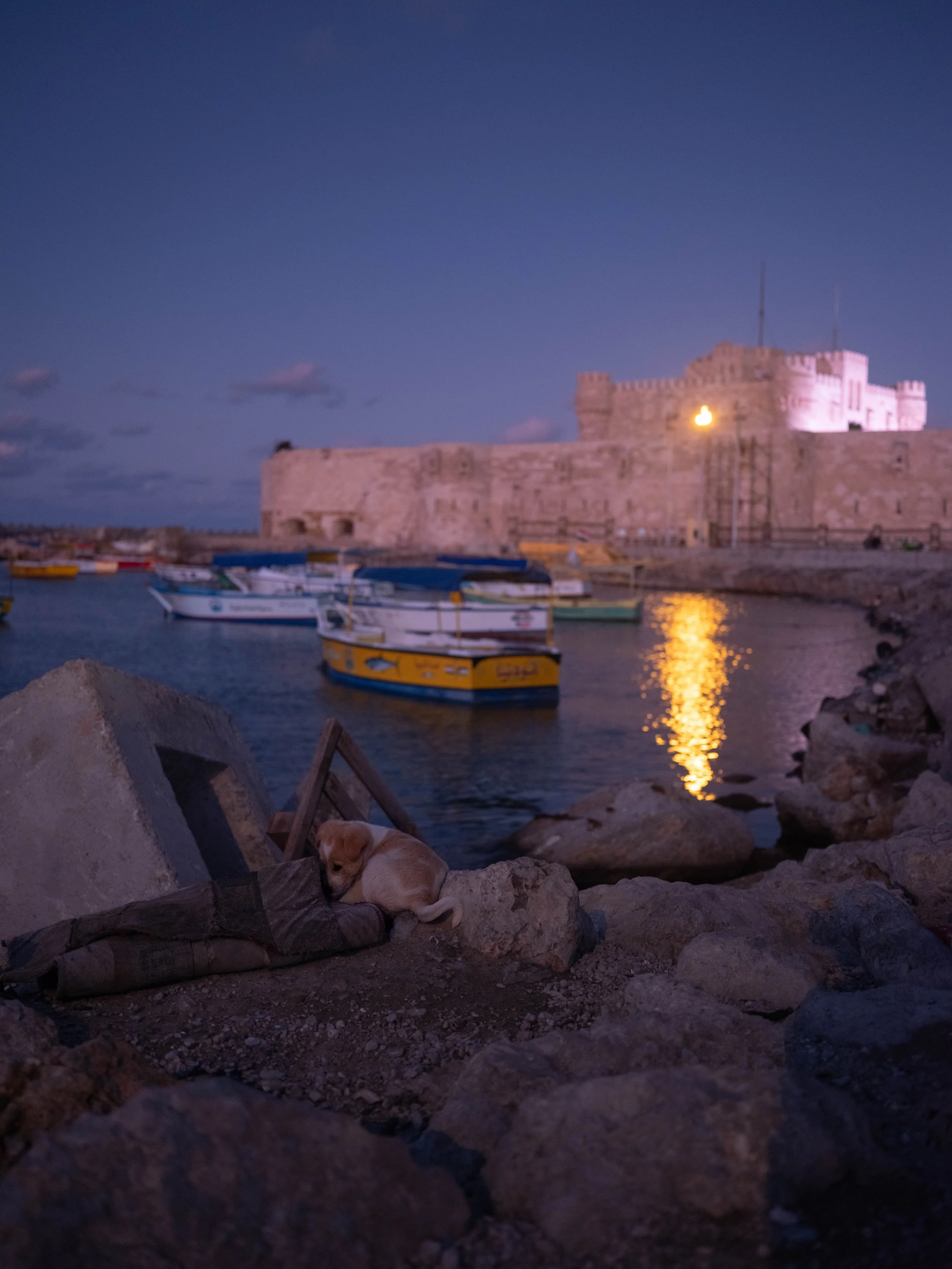
Alexandria, January 2026